
What Is Compulsive Lying And Why Does It Happen?
Compulsive lying describes a persistent pattern of dishonesty that continues even when the lies serve no clear purpose. Real harm follows, often to the person telling the stories and to everyone around them. Unlike an occasional exaggeration or a white lie told to smooth over an awkward moment, this pattern repeats itself without a strategic reason behind it.
Clinically, compulsive lying is not listed as its own diagnosis in the DSM-5-TR, the diagnostic manual used across psychiatry. It frequently shows up alongside personality disorders, however, and the damage to trust can be severe. Families often describe feeling exhausted, confused, or constantly on guard.
Why Does Someone Lie Compulsively?
The honest answer: no single cause explains every case. What’s consistent is the fallout. Relationships strain, work performance suffers, and the person’s own sense of identity can start to blur under the weight of stories that no longer match reality.
Is Compulsive Lying A Sign Of Something Deeper?
Often, yes. Because the pattern tends to travel with underlying personality or mood conditions, a thorough psychiatric evaluation matters more than a label.
Comprehensive psychiatric care, including evaluation, medication management, psychotherapy, and other evidence-based options, gives families a path forward. Compulsive lying therapy works best as a form of mental health treatment for lying that looks at the whole person, not just the behavior on the surface.

How Do You Find The Right Treatment Path?
Finding the right path starts with an honest look at the pattern itself and the support available nearby. Zoelife Psychiatric Services® offers quick access to both in-person and virtual specialists when mental health issues interfere with daily life, work, or close relationships. A clinician experienced in compulsive lying treatment can help untangle the pattern and begin rebuilding trust, whether the person telling the stories asks for help or a worried family member reaches out first.
Treatment works best when it considers the whole person, not just the behavior causing concern. Zoelife integrates personalized, evidence-based care with specialist access across both in-person and virtual settings. Families can choose whichever format fits their schedule and comfort level. Age-specific programs address related struggles like trauma, anxiety, and drug use disorders, since lying patterns often develop alongside other conditions. These programs are built separately for children, teenagers, young adults, and adults, meeting each age group where it stands.
A strong care path generally includes:
- Quick access to specialists, in person or by video
- An evaluation that considers underlying trauma, anxiety, or substance use
- Age-appropriate programming matched to the person affected
- Ongoing therapy focused on rebuilding trust with loved ones
What does treatment for a pathological liar actually involve?
Treatment for a pathological liar typically centers on therapy exploring why the lying started and what sustains it. Effective therapy for compulsive liars pairs a trained therapist with the individual, sometimes including family members, to rebuild honest communication over time. No single session resolves the pattern. Consistent psychotherapy for chronic lying, paired with patience from everyone involved, tends to make the real difference.
What Happens During Therapy Sessions For Compulsive Lying?

Sessions for chronic lying patterns combine structured conversation with practical skill-building, not a single fixed script. Zoelife Psychiatric Services® offers a responsive, trauma-informed, and culturally competent approach to compulsive lying treatment, grounded in evidence-based strategies rather than guesswork. Clinicians typically open with assessment, move into pattern recognition, and close with a plan for preventing relapse.
Before deeper work begins, clinicians need a clear picture of the person sitting in front of them. Research referenced by Drew Curtis, PhD, notes that a small percentage of people lie far more than average, making lying a way of life rather than an occasional habit. That distinction shapes everything that follows.
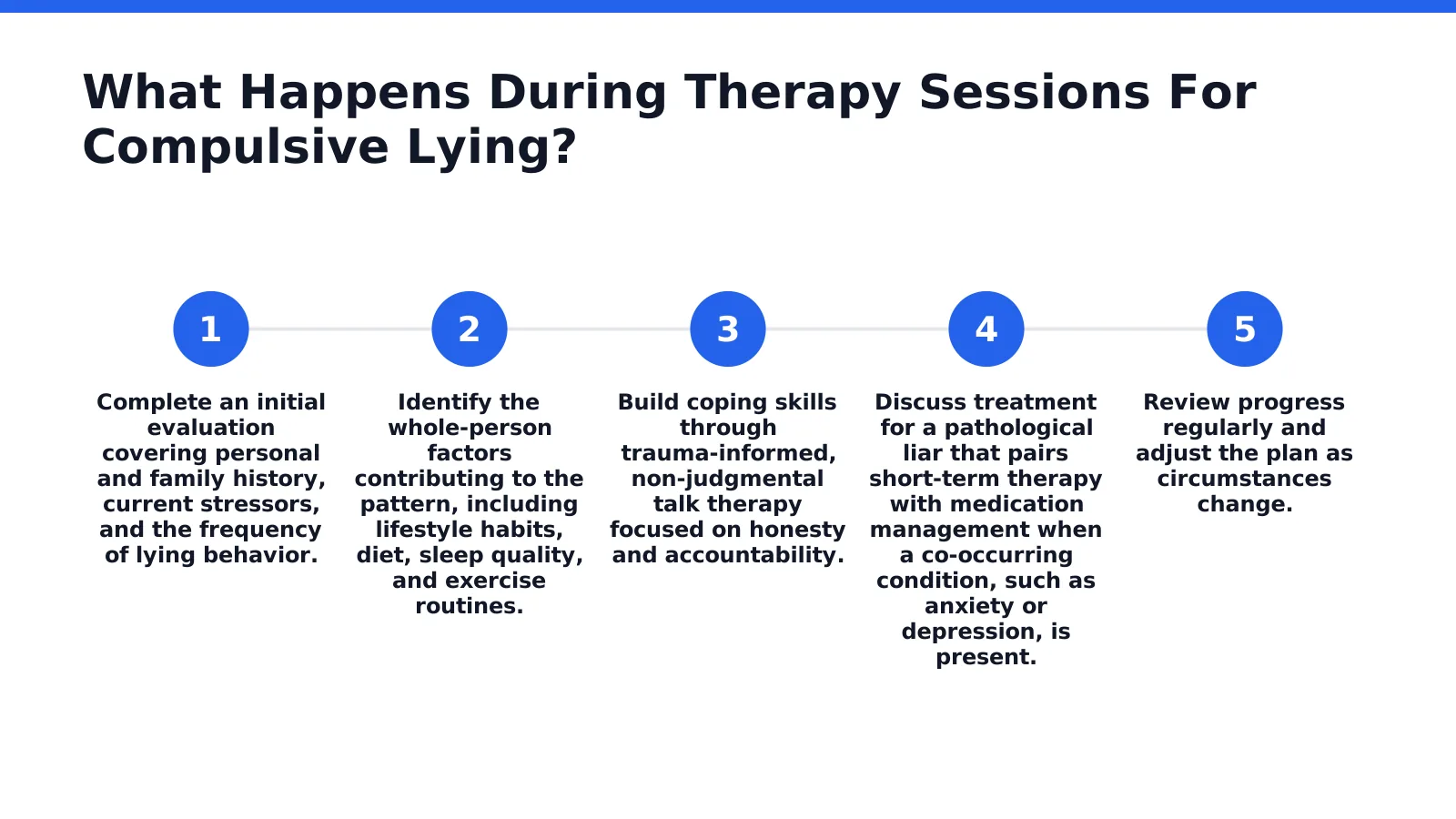
A typical course of sessions unfolds in this order:
- Complete an initial evaluation covering personal and family history, current stressors, and the frequency of lying behavior.
- Identify the whole-person factors contributing to the pattern, including lifestyle habits, diet, sleep quality, and exercise routines.
- Build coping skills through trauma-informed, non-judgmental talk therapy, often drawing on CBT for compulsive lying to identify the distorted thought patterns that sustain the behavior and replace them with honesty and accountability.
- Discuss treatment for a pathological liar that pairs short-term therapy with medication management when a co-occurring condition, such as anxiety or depression, is present.
- Review progress regularly and adjust the plan as circumstances change.
What Does Progress Look Like In Early Sessions?
Early sessions often focus on building trust and reducing shame around the behavior rather than demanding immediate change. Clients start noticing their own triggers before they’re expected to stop the behavior entirely. Family members may be invited in, depending on the situation, since lying rarely affects only one person.
Treatment stays individualized throughout, since no two clients arrive with the same history or needs.
How Can Families Help Rebuild Broken Trust?

Families rebuild trust through structured, professional support rather than willpower alone. Clear steps, paired with compulsive lying treatment guided by a clinician, give both the individual and loved ones a path forward instead of a cycle of suspicion.
Loved ones of someone who lies constantly often describe a particular exhaustion: replaying conversations, searching for the thread of truth, questioning their own memory. That exhaustion is real, and it deserves acknowledgment before any rebuilding can begin. Trust does not return simply because someone promises to change. It returns through consistent, observable steps taken over time.
- Name the pattern honestly, without framing it as a moral failing.
- Seek an evaluation that looks at the whole person, not just the lying behavior.
- Agree on small, verifiable commitments rather than sweeping promises.
- Attend sessions together when appropriate, so progress is witnessed, not just reported.
- Track progress patiently, since relational repair happens gradually.
Does family involvement actually speed up recovery?
Family involvement does not replace individual treatment, but it reinforces it. Zoelife Psychiatric Services structures care around restoring each person’s wholeness, an approach that benefits the surrounding relationships as much as the individual receiving care.
What if cost is a barrier to getting help?
Cost concerns should not delay a first conversation. Zoelife partners with most insurance providers in its network, which helps make ongoing treatment for pathological liar behaviors more accessible for families working through this together. Serving the Chicago area, the clinic offers personalized, evidence-based care built around each family’s specific situation.
What Mistakes Should You Avoid During Recovery?

Recovery stalls most often when families expect a quick fix or treat chronic lying as a fixed personality flaw rather than a pattern that responds to care. Pathological lying treatment works best when the behavior is understood as a distinct, treatable condition, not a permanent character trait. Writing someone off too early is one of the costliest mistakes a family can make.
A second common error is confusing occasional fibbing with the automatic, repeated lying that signals a deeper pattern. Waiting for the “right” moment to intervene, rather than acting once lying starts happening without clear reason, delays meaningful compulsive lying treatment and allows mistrust to deepen in relationships.
Is medication the main treatment for a pathological liar?
Medication is rarely the centerpiece of effective treatment for a pathological liar. Zoelife’s prescribing approach favors the minimal effective dose, limits the number of medications, and restricts controlled substances, using medication as a short-term support rather than a standalone fix.
Can someone actually recover from compulsive lying?
Recovery is possible when lying is approached as a treatable pattern rather than a permanent trait. Progress tends to come through consistent, whole-person care rather than any single intervention.
Common missteps to avoid during recovery include:
- Assuming medication alone will stop the lying behavior
- Dismissing the pattern as “just who someone is”
- Overlooking safe tapering plans when medication is involved
- Ignoring the shift from occasional dishonesty to automatic lying
Avoiding these errors keeps families and individuals focused on sustainable, individualized progress.
FAQ
Is compulsive lying a diagnosable mental health condition?
Compulsive lying is not a standalone DSM-5-TR diagnosis. It frequently occurs alongside personality disorders. A thorough psychiatric evaluation identifies the underlying condition driving the behavior rather than relying on a single label.
What does treatment for compulsive lying actually involve?
Treatment combines psychiatric evaluation, medication management, and evidence-based psychotherapy. Zoelife Psychiatric Services® addresses underlying trauma, anxiety, or substance use through personalized, trauma-informed care that looks at the whole person.
How does Zoelife Psychiatric Services support someone with this pattern?
Zoelife offers quick access to specialists in person or virtually across Illinois and Florida. Age-specific programs for children, teens, young adults, and adults help rebuild trust and address related struggles.
Conclusion

In closing, compulsive lying responds to treatment when approached as a treatable pattern rooted in real struggles, not a character flaw or permanent trait. Recovery unfolds through consistent, whole-person care that addresses underlying trauma, anxiety, or other conditions driving the behavior. With professional support, honest family involvement, and patience, individuals and their loved ones rebuild trust and restore the relationships that matter most. The path forward exists; it simply requires the willingness to begin.


